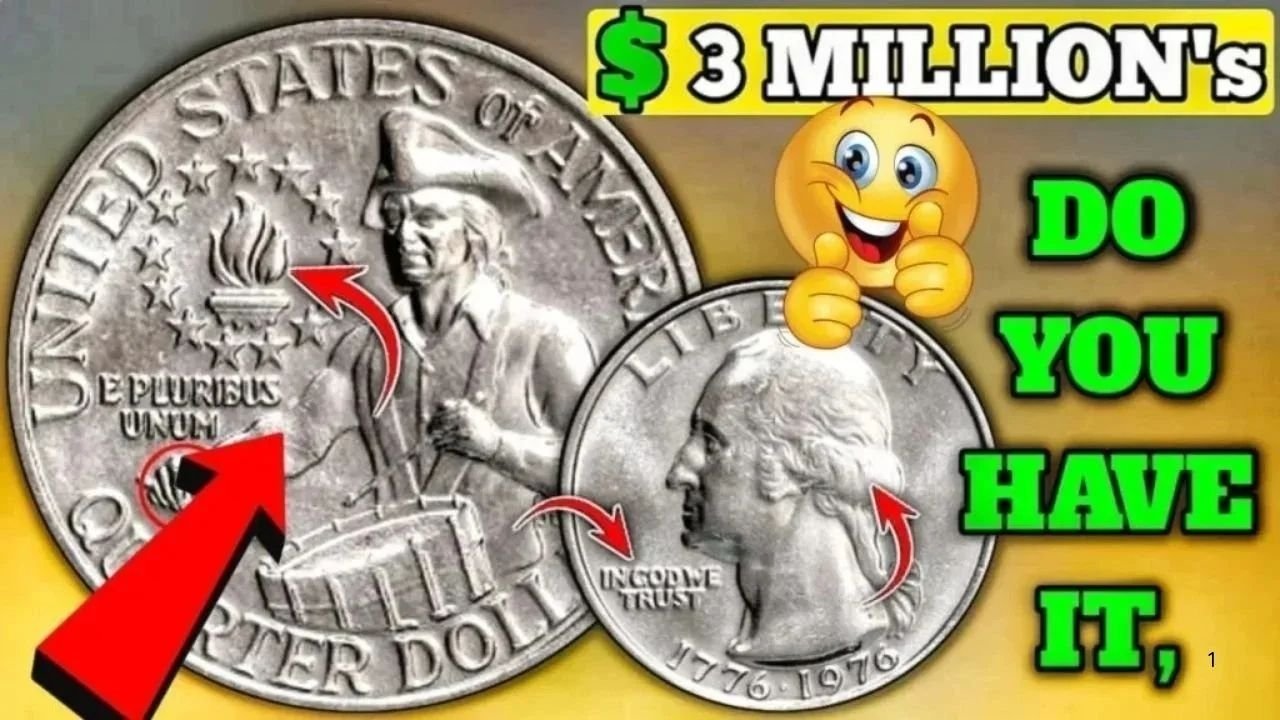
Coin collectors love the thrill of uncovering hidden treasures, but few coins create as much excitement as the 1976 Bicentennial Quarter. While hundreds of millions were minted for America’s 200th anniversary, a tiny number contain rare errors or silver strikes that can make them worth thousands—or even up to $3 million. This guide explains what makes these coins valuable and how to check if your quarter could be one of the rare ones.
A Short History of the 1976 Bicentennial Quarter
To celebrate 200 years of American independence, the U.S. Mint released a special quarter in 1976 with a unique design featuring:
- A Colonial drummer boy
- A torch surrounded by 13 stars
- Dual date 1776–1976

These quarters were minted in two main versions:
- Standard copper-nickel circulation coins
- Limited 40% silver coins, mainly sold to collectors
Why Some Bicentennial Quarters Are Worth Millions
Although most Bicentennial quarters are still worth face value, rare errors and special silver strikes can push their value into the thousands—or more. Here are the varieties collectors prize the most.
1. Silver Planchet Error Coins
A very small number of regular-strike quarters were mistakenly produced on 40% silver planchets intended for collector sets.
These error coins are incredibly rare and have reportedly sold for:
- Hundreds of thousands
- Up to $3 million in exceptional graded condition
2. Double Die Errors

A double die occurs when design elements are accidentally stamped twice. Look for doubling on:
- LIBERTY
- IN GOD WE TRUST
- Drummer boy’s details
Strong, clear doubling can make these coins extremely valuable.
3. Off-Center Strike Errors
If the coin’s design is not perfectly centered:
- 5–10% off-center: small premium
- 30%+ off-center: very rare and high-value

Coins showing dramatic misalignment are especially desirable.
4. San Francisco Silver Proof and Uncirculated Coins
Coins with an “S” mint mark may come from:
- 40% silver proof sets
- 40% silver uncirculated sets
High-grade proof coins (PR-68, PR-69, PR-70) often sell for hundreds, sometimes thousands.
5. High-Grade Certified Coins
Collectors pay a premium for quarters graded MS-68 or higher by:
- PCGS
- NGC
Because few coins survive in perfect condition, these top-tier grades can command impressive prices.
How to Identify a Rare 1976 Bicentennial Quarter
You can quickly check your coin using these simple steps.
Check the Mint Mark
On the right side of Washington’s portrait:
- S = San Francisco (potential silver)
- D = Denver
- No mint mark = Philadelphia
Inspect the Edge
A silver Bicentennial quarter will have:
- No copper-colored stripe
- A clean, solid silver edge
Weigh the Coin
Use a digital scale:
- 40% silver: about 5.75 g
- Copper-nickel: about 5.67 g
Even a small difference is important.
Look for Errors
Use a magnifying glass to inspect:
- Letters
- Date
- Drummer boy details
- Rim alignment
Any unusual strike, doubling, or missing design could mean a rare variety.
Get the Coin Professionally Graded
If your coin appears flawless or unusual, send it to:
- PCGS
- NGC
A professional grade greatly increases market value.
Current Market Values
Rare Bicentennial quarters—especially silver planchet errors—have reached valuations as high as $3 million. Even common silver proof coins can deliver strong value when certified at top grades.
Frequently Asked Questions
Q1: Are all Bicentennial quarters valuable?
No. Only rare errors, silver varieties, and high-grade coins have significant value.
Q2: How can I check if my quarter is silver?
Look at the edge. Silver coins show a solid silver color with no copper stripe.
Q3: Can circulated coins still be valuable?
Yes. Error coins can be valuable even with wear.
Q4: Where can I get my coin checked?
PCGS and NGC are the most trusted grading services.
Q5: What is the highest known value for a Bicentennial quarter?
Some rare silver-error quarters have been valued at up to $3 million.
Conclusion
The 1976 Bicentennial Quarter is more than a patriotic collectible—it could be a hidden fortune. With a quick check of mint marks, weight, edge color, and possible errors, you might discover a rare variety worth thousands or even millions. So before spending your spare change, take a close look. You may be holding a piece of American history—and an unexpected treasure.